← Back to portfolio
Growth / Retention

WhatsApp Re-Engagement Pipeline

Chimple Learning · 2025

Could a targeted WhatsApp nudge bring back students who had stopped using the app? I treated the question as an experiment rather than assuming another broadcast would solve the problem.

Context

Chimple tracks students across four engagement states: Activated, Active, Inactive, and Activated but Inactive.

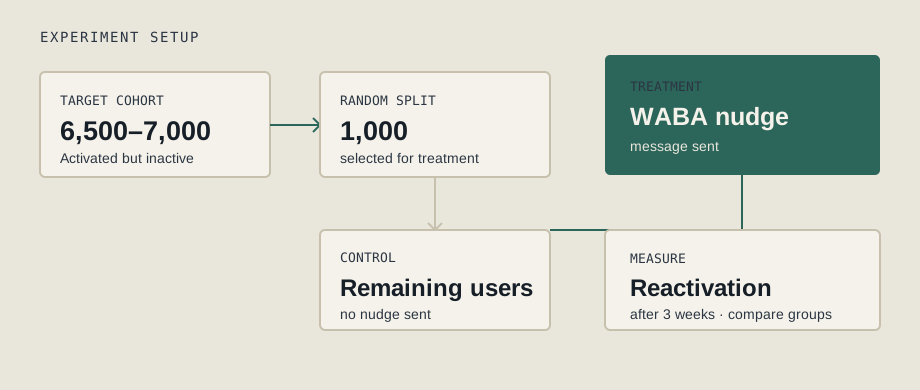
The last group was particularly important. These were students who had played at least one lesson in the past, but had not opened the app in the last 7 days. The Teacher's App dashboard surfaced them as a red-flag group, and at any given time, there were around 6,500–7,000 students in this state.

We already had WhatsApp groups for communicating with parents, but coverage was inconsistent and most messages were generic. The program team also did some manual outreach, but we didn't have a clear way of knowing whether these interventions were actually bringing students back.
The problem

The challenge wasn't that students were actively leaving the product. They were simply becoming inactive without any obvious signal.

We had a large pool of students who had previously engaged with the app but had not returned for more than a week. There was no validated re-engagement mechanism in place, so we were relying on manual outreach and assumptions about what might work.

Could a targeted WhatsApp nudge actually reactivate students who had stopped using the app?
Approach

I treated the first rollout as a controlled experiment.

From the pool of approximately 6,500–7,000 Activated-but-Inactive students, I used our Looker dashboard to pull and segment the cohort. I randomly selected 1,000 students as the treatment group, while the remaining students became the control group and received no nudge.

The message was intentionally simple. It was a parent-facing WhatsApp message explaining that their child had not completed homework recently and reinforcing the importance of regular practice.

I deliberately didn't start with personalization or complex messaging logic. The first question was more fundamental: does reaching the right users at the right time make a measurable difference?

What I shipped

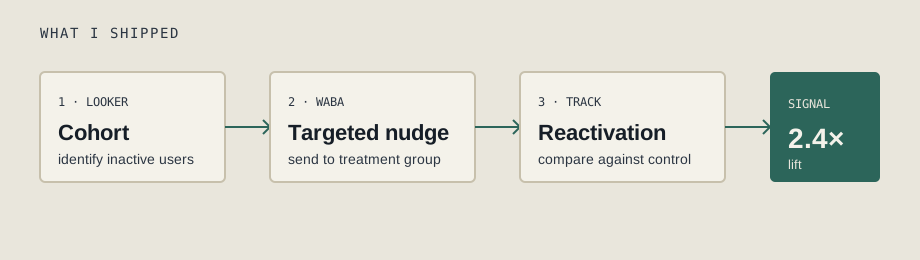
I put together an automated WhatsApp Business API (WABA) re-engagement pipeline that connected:

Looker cohort → targeted WhatsApp message → reactivation tracking

The treatment group received the nudge, while the control group received nothing. We then tracked reactivation over a 3-week period and compared the two groups.

Results
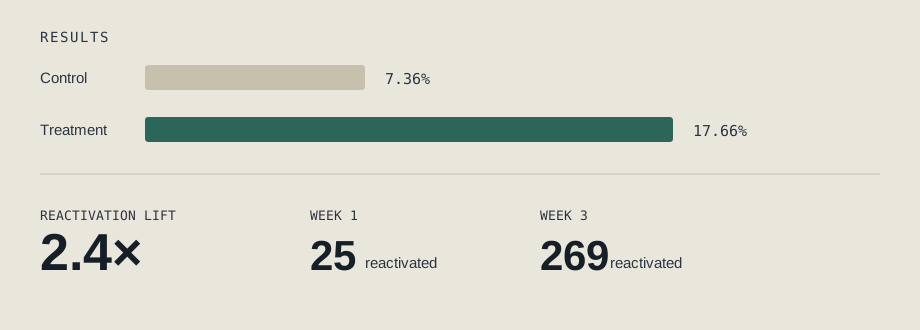
7.36% → 17.66%
Reactivation rate: control → treatment
2.4×
Increase in reactivation rate

The number of reactivated students also increased during the experiment, from 25 students in week 1 to 269 by week 3.

This gave us evidence that targeted WhatsApp outreach could be an effective re-engagement mechanism rather than simply another communication channel.

What I learned

The most interesting part of the experiment wasn't the message itself.

The message was relatively simple and wasn't personalized by student name or lesson history. What mattered first was identifying which students had become inactive and reaching them at the right point in their engagement journey.

That changed how I looked at the problem. Instead of starting with, “How can we make the message smarter?”, the more important question became, “Are we reaching the right user at the right time?”

If I were taking the experiment further, I'd test whether lightweight personalization — such as referencing the student's name or the lesson they had previously started — could improve the result further.